


How to engage agents in their activity metrics by using simple sales gamification techniques
When I came to sell my first home a decade ago, I agreed an exclusive contract with an estate agent with a slightly lower rate than the alternatives and a social way to spend its profits.. My thinking was that houses sell on rightmove (after all that was how I found and bought houses) and that the agent makes minimal difference so I might as well pick an agent that does some good.
How wrong I was! After 3 months there had been zero enquiries, so I took the decision to exit the contract and switch agents. This new agency was slightly more expensive but crucially offered to sell the house using his team of 4 agents rather than the competitors two..
Shortly, they had rung round all the potential buyers they knew to let them know about the house, we had our first and second viewing (the buyer’s father) and before I knew it, the house was sold!
From this I learnt the importance of agents and sales activity when it comes to selling houses. You can’t just leave it to the internet.
Of course as a professional estate agent you already know this.
But often motivating yourself or your colleagues to make those crucial sales calls isn’t a surefire thing. So many of us have good intentions but actually doing it is something different.
In recent years one psychological approach to encouraging great behaviours has been to use the techniques that video games use to keep us playing and apply them to the world of work. It’s called “gamification” and it can be applied to sales and the world of estate agents.
The principle is really simple – if you provide feedback on performance in a simple way, for instance with a score, then that makes it easy for anyone to see what they need to do to improve. Good, relevant and timely feedback leads to behaviour change and improved performance.
As I explain in my book, Infinite Gamification, using gamification techniques isn’t rocket science – indeed we already use them whenever we share an ordered list of sales results, it’s really about tweaking how you share those stats to get the best results.
There are three really useful principles that you can apply to sales activity metrics – like call prospecting and sending emails that work to “gamify” behaviour:
Simplify metrics into a single score
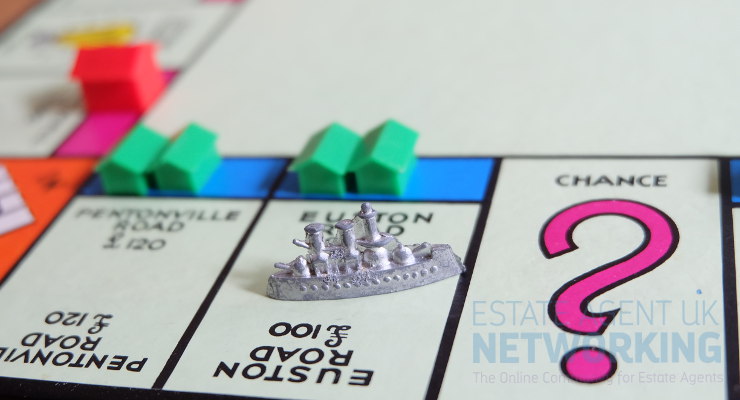
One of the great tricks of any game is to boil down a complex series of activities into a single score. For example, in the board game Monopoly, you have to buy and sell property, participate in auctions, decide when to buy houses and so on – this complexity is simplified into a single way to keep track of score – how much monopoly money you have. The person with the most money at the end of the game wins.
Similarly in sales metrics – you can allocate scores to activities – say 3 points for a call, 1 point for an email – to come up with a single score. If the activities are too different – for example you might have a metric of time taken to respond to a customer query – then in this case you can rank everyone’s average time and give each person a score based on how they rank.
Make the score announcement a news event
The digital world is fundamentally a media world – that’s why social media is so huge. Too many sales metrics are buried in an “always on dashboard” that no-one looks at or inside a CRM system report that no-one clicks on.
To get attention you need to announce the score as a news event that can be shared on whatsapp, slack, email or teams. Whether daily, weekly or monthly, by announcing it as a news event you can be sure that your colleagues will notice the score. So don’t opt for sharing metrics in real time, save your gunpowder and make it a news story once a week.
Tell each agent their own data story
Getting attention is only half the battle, you also need to tell a simple data story that triggers an emotional reaction. That emotional reaction is what then triggers a desire to change behaviour (usually to do even better next week).
A data story needs to be simple so that the person reading it can tell at a glance quite quickly what the data is saying. If they want to find out more they can drill down into the underlying data but at the top it must be simple.
I’ve found two great data stories that usually work: firstly, your change in total score week to week – everyone is interested in whether they’ve gone up or down. FitBit famously do this well with the daily step count, anyone with a FitBit can usually tell you whether they hit their 10,000 steps target yesterday. The other data story, which is particularly suitable for go getting sales agents, is “rank relative to peers” – knowing you nudged ahead of a colleague on your activity stats that week is always interesting to know.
So there you have it, 3 great “sales gamification” tips to make sure you and your colleagues really take notice of sales activity metrics and use that attention to drive better sales activities and ultimately lead to more results.
Toby Beresford is CEO of Rise.global – a sales gamification platform for tracking sales activity metrics and sharing them as data stories. Find out more at rise.global/pages/sales

You May Also Enjoy
Leasing demand rises across all sectors
Don’t Put The Property Market On Pause

Before You Sign: 10 Things Home Movers Wish They Knew

Property expert warns homeowners to lock in amid mortgage rates uncertainty
Damp and mould online searches rise by 34%