House price growth remained subdued in July

- UK annual house price growth slowed to 1.8% in July, from 2.2% in June
- House prices were up 0.1% month on month
- Average time in a home is 14 years: 24 years for those owning outright and 5 years in private rented sector
- Three quarters of moves were within same tenure type in 2024/25
| Headlines | Jul-26 | Jun-26 |
|---|---|---|
| Monthly Index* | 551.1 | 550.6 |
| Monthly Change* | 0.1% | -0.0% |
| Annual Change | 1.8% | 2.2% |
| Average Price
(not seasonally adjusted) |
£277,542 | £277,484 |
* Seasonally adjusted figure (note that monthly % changes are revised when seasonal adjustment factors are re-estimated)
Commenting on the figures, Robert Gardner, Nationwide’s Chief Economist, said:
“UK annual house price growth edged down to 1.8% in July, from 2.2% the previous month. Prices remained broadly flat in month-on-month terms, after taking account of seasonal factors.
“Market activity and house prices have remained soft in recent months, in part reflecting the uncertain economic backdrop. Geopolitical tensions remain high, with the conflict between Iran and the US again exerting upward pressure on energy prices and market interest rates in recent weeks. Financial market expectations for the future path of Bank Rate have been volatile, reflecting shifting views about the inflationary implications of events at home and abroad.
“Despite the ongoing risks from the latest energy price shock, the Monetary Policy Committee can take some comfort from the fact that consumer price inflation declined further in June. Signs that wage growth has continued to ease gives policymakers more breathing space to assess the extent to which tighter policy is necessary to ensure inflation returns to target.
How long do people stay in their homes?
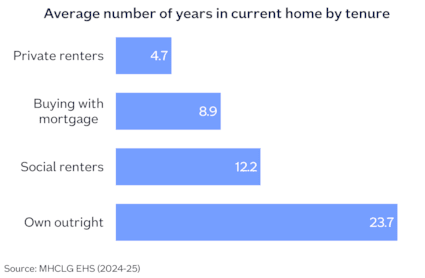
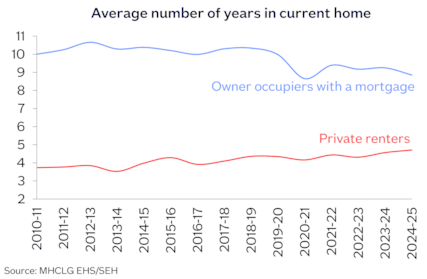
“The latest data from the English Housing Survey reveals the average length of residence across all tenures has been broadly stable since 2010/11. The average time spent in a home is around 14 years, although this masks significant differences across tenure types, as illustrated in the charts below.
“Those who own their home outright tend to have lived in their current home for much longer than other tenure types, at nearly 24 years on average. However, there is a significant skew in the data, with around a third of those owning outright living in the same property for 30 years or more (see chart below).
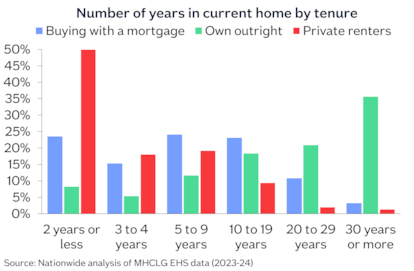
“Those in the private rented sector tend to have the shortest time in a property. There is also a heavy skew (although opposite to those owning outright) with around half of those in the private rented sector being resident in their current property for two years or less.
“There has been a small increase in the average residence in the private rented sector over the last decade, while those owning with a mortgage have seen a small decline. The latter may be partly due to homeowners with a mortgage moving more frequently, although compositional changes may also be playing a role (for example, as the population ages and more people transition into owning outright). Around a quarter of those owning a home with a mortgage had been in their current home for two years or less, suggesting higher first-time buyer activity in recent years may also be a factor.
Which is more important – churn within or between tenure types?
“As well as considering how long households stay in a given property, it’s also interesting to consider the current pattern of activity and how much churn in the housing market occurred within and between tenure types.
“The data for households who moved in 2024/25 (the most recent data available) indicates that moves within tenure types dominate (see chart below). Indeed, around three quarters of all moves were within the same tenure type and a quarter between tenure types.
“Those moving within the private rented sector accounted for the largest share of overall activity, with 640,000 moves within the sector, nearly twice as high as the number moving within the owner-occupier sector.
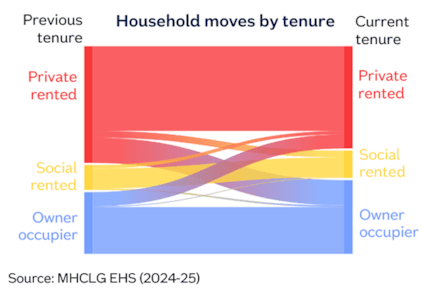
“The moves between tenure types are still significant. For example, nearly 200,000 households previously in the private rented sector became owner occupiers in 2024/25. But there is also a return flow, with around 100,000 households moving into private rented properties having previously been owner occupiers.”

You May Also Enjoy
The UK towns boasting +80% house price growth amid nationwide drop

London remains destination of choice for international property wealth

First drop in rental supply in three years pushes rents higher

Breaking Property News 13/9/26

Back-to-school buyer bounce outpaces typical September uplift