Breaking Property News – 13/03/24

Daily bite-sized proptech and property news in partnership with Proptech-X.
How to elevate your Portal with AI property search?
According to Ascendix Technolgies, ‘Property search is usually a hard task requiring plenty of effort, research, and time. To accomplish this, the majority of modern rental marketplaces offer keyword search in combination with filters and Geosearch. However, if future tenants are not sure about what exactly they want, or are just browsing, these search approaches simply do not work.
Imagine if users could talk to the search bar, just like they talk to ChatGPT, and get results that fully match their needs. It would be like having a conversation with a friend who understands exactly what they’re looking for.
AI-powered search and Natural Language Processing algorithms do just that. In our article, we explore how this process happens, and investigate AI search from the perspective of a customer and the technology behind it.
Traditional Property Search and What’s Wrong with It?
Most real estate portals and booking websites employ a combination of keyword and faceted search (filters and sorting), e.g., Booking.com or Airbnb, with the addition of Geosearch.
While filtering involves toggling through property criteria, keyword search aims to precisely match user queries with website content, akin to using a book index.
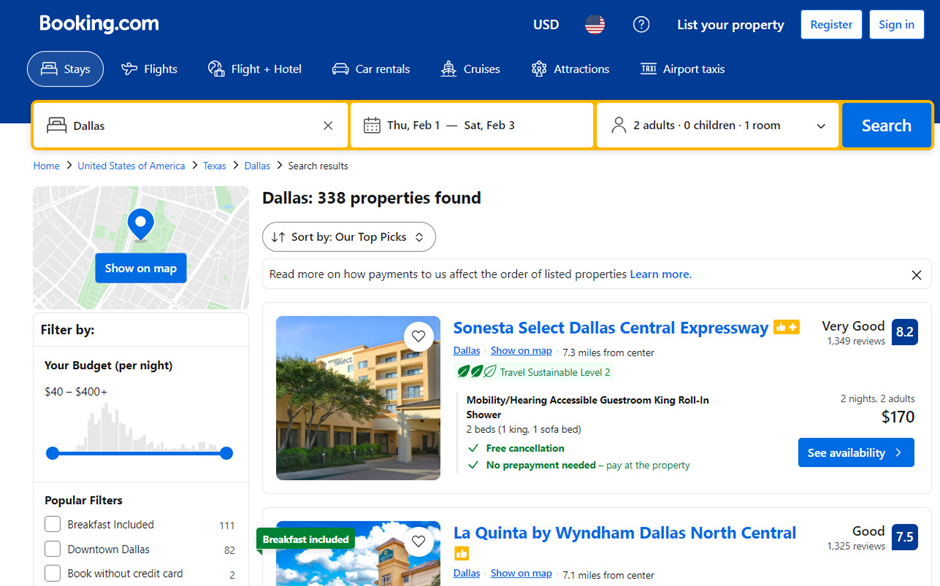
Traditional Filter Search | Source: Booking.com
Despite being straightforward and familiar to users, these search algorithms may not always be effective in the real estate context. For keyword search, for example, obvious drawbacks are:
- Lack of context. Keyword search rarely has the ability to understand the context, leading to potential misinterpretations of the query, and, therefore, irrelevant results. For instance, the real estate term ‘flat‘ may refer to an apartment, a characteristic, or informal pricing, leading to potentially irrelevant results.
- Limited understanding of user’s intent. It may not adapt well to changes in user intent during a single search session, consequently leading to results misinterpretation. This way if you searched for ‘London parks’ and then decide to find a place for your car to ‘park in London,’ you are likely to see more green spaces, instead of places to park a vehicle.
- Insufficient results for long queries. If the user learned a lesson and decided to include extra details in the query, surprisingly it may fail just as well. Extremely specific or long-tail queries may not yield accurate results, as the system will struggle to match the exact combination of keywords entered by the user. Apparently, if you are looking for a ‘three-bedroom family house Virginia parking garage,’ only a few of your requests will be fulfilled in the search results.
- Inability to understand language variations. Keyword search may not account for synonyms, alternate spellings, or variations of terms, potentially causing relevant content to be overlooked. Ambiguity in the keyword query which has multiple meanings often leads to irrelevant results, and even punctuation may cause trouble. So, ‘2 bathrooms house Dallas’ and ‘two-bathroom house Dallas’ can have very different search results.
- Dependent on the query quality. The quality of search results heavily depends on the accuracy and specificity of the keywords. Users who use vague, ambiguous, or not very specific terms may struggle to find the desired information. Golden mean between clarity and conciseness is a must when dealing with keyword search, but it may be troublesome to reach.
Filters and sorting on the other hand fall victim to the following drawbacks:
- Limited flexibility. With filter search, the user can only choose from pre-defined categories of properties, available on the marketplace. This way, there is a limited possibility of customized and personalized choices. The user cannot insert their own filters from the very beginning but has to look for the appropriate ones by scrolling down through a lengthy list, which means more time and effort spent on the search.
- Manual, time-consuming, and tiring. Filtering your way to the dream property may be tedious, lengthy, and boring: because of a huge variety of filters on marketplaces, the user is likely to spend a lot of time scrolling through options while searching for the appropriate place for rent.’
Propflo smart heat loss assessments now available to West of England homeowners with £250 voucher
Propflo has now been approved as a supplier for subsidised smart home heat loss and draught assessments via Retrofit West. Funded by West of England Mayoral Combined Authority and Retrofit West, homeowners can get £250 off advanced AI powered smart home insights into heat loss, draughts, as well as damp, mold and poor indoor air quality risks. Packages now start from £129 instead of £379.
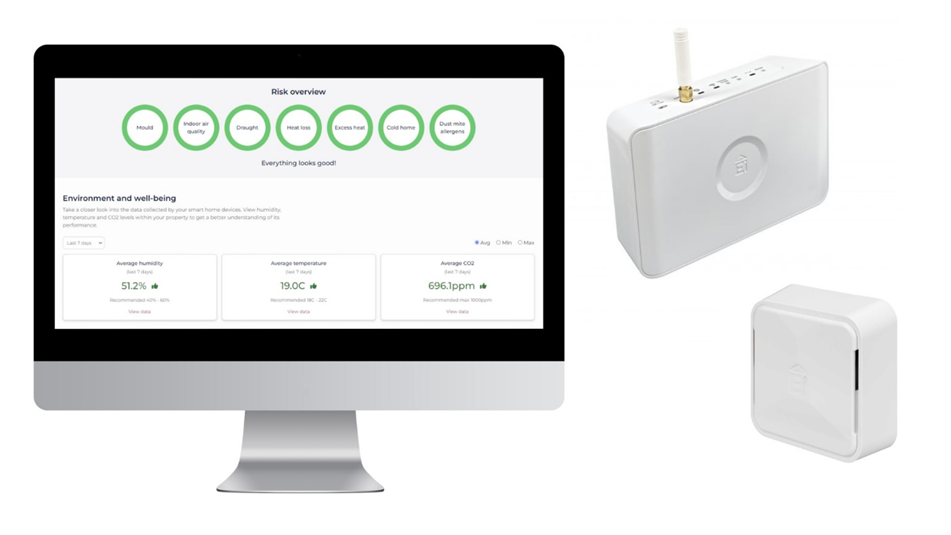
The Aico Homelink devices and insights available via Propflo (Pic)
This builds on the recent integration of one of the leaders in real-time thermal efficiency and environmental monitoring – Aico Homelink – and Propflo’s Retrofit-as-a-Service platform. Aico Homelink is a proven technology with over 300,000 sensors deployed.
A key difference with other heat loss assessments is that this is not a one-time analysis; homeowners are able to see differences and the impact of works over ten years, in the Propflo HomeHub, and also access wider insights like mould risk. It complements other assessments like thermal surveys by helping to understand if these are needed, better target improvements, and then monitor the impact of these improvements.
How will it work?
Homeowners just apply for a Home Assessment Voucher at retrofitwest.co.uk/vouchers. Once the voucher has been issued, homeowners can then contact Propflo with the voucher code to purchase the smart home assessment package they require.
The smart home sensors will be sent and installers will contact the homeowner to book an installation date. Once the sensors are installed the homeowner can access the Propflo HomeHub with the results after seven days of collecting data.
Homeowners could also access up to £2,600 of additional benefits including discounts on improvements and more smart home tech to increase coverage in the home, via another Propflo project funded by Innovate UK. On application Propflo will let the homeowner know if they are also eligible for this. If you are interested, please do reach out to contact@propflo.co.uk with the subject ‘Heat loss assessment.’
Luke Loveridge, Founder and CEO, Propflo, ‘This is an exciting opportunity for homeowners in Bristol, Bath and South Gloucestershire to get access to some of the leading technology for detecting heat loss, draught as well as damp and mold risk at a generously subsidised price. It will help with making properties more energy efficient, and crucially healthier as well.’
Simon Andrews, Managing Director, Retrofit West comments, ‘Our home energy assessment vouchers are designed to help people better understand what works are needed to help them save money on their energy bills as well as keep their homes comfortable and healthy. The Propflo thermal assessment is an innovative option for understanding heat loss and draughts on an ongoing basis. We’re pleased to have them as one of our trusted suppliers.’

Propflo is an award winning data-driven AI platform that supports lenders and property businesses to comply with energy efficiency regulations, meet their climate targets, and then support their customers in their wider ownership journey. Founded by proptech entrepreneur Luke Loveridge and geospatial and risk data scientist Dr Daniel Moyo. It also has world leading AI expert Mike Tipping as an advisor.
Retrofit West Advice is a West of England Mayoral Combined Authority project. It is part of a wider retrofit project that aims to build the supply chain, supporting local businesses and delivering green skills development for residents. The Combined Authority is funding the project through its Green Recovery Fund, a £60m pot to help meet the region’s climate and ecology ambitions.
Andrew Stanton Executive Editor – moving property and proptech forward. PropTech-X

You May Also Enjoy

Seven things to do if a tree damages your property

Leasing demand rises across all sectors

Don’t Put The Property Market On Pause

Before You Sign: 10 Things Home Movers Wish They Knew

Property expert warns homeowners to lock in amid mortgage rates uncertainty