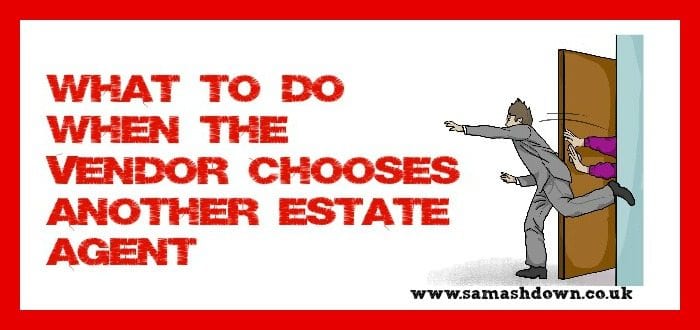
What to do when the vendor chooses another estate agent
A lovely agent called Brian wrote to me this week. He had an interesting question:
“What can I do when the vendor decides not to instruct us, but chooses one of our (cheaper) competitors instead? Do I calmly walk away or do I keep in touch with them? We lost an instruction recently to an agent because their fees worked out £300 cheaper! How do you suggest I react to that when the client didn’t even give me the chance to match their fee?!”
Good question!
First I need to say that it’s highly unlikely the vendor in question chose another agent for a £300 fee difference. The reasons people do what they do and choose a particular service provider go much, much deeper than money.
Let me ask you something: when was the last time you bought something significant? Maybe a new car, special outfit or a gym membership? Think back to your purchase decision. I’m sure the cost involved was part of your decision-making process, but I’m guessing it wasn’t more than about 20% of your final choice. Am I right?
Take your watch as an example. When you bought it, you probably told yourself you needed a watch so you could tell the time, right? (We’ll ignore for a moment that you almost certainly carry around a time-telling piece of tech wherever you go, ie your phone.) So if I do a quick Amazon search for ‘watch’, I can see that I could buy quite a nice looking watch for £1.78. It even has a five star rating from 22 reviewers so it’s probably a pretty good purchase.
So how much did your watch cost? More than £1.78?More than £10? £100? Over £1,000?
When you bought your watch, you were not, in fact, buying the ability to tell the time. You were buying something entirely different, and much more important to you. Maybe it was a reward for all the long days and weekend working. Perhaps it was the aesthetics that drew you to it, because you wanted something attractive to adorn your arm. Or you consider yourself a techie, and you were looking for a gadget that would entertain and inform you.
Chances are, whatever your reasons for buying a new watch, you were not buying on price, and you were buying much more than the time.
What was Brian’s vendor thinking?
When she was deciding which agent to choose, she was trying to weigh up lots of different aspects and criteria. Did she like both the agents? Did either of them come recommended? Did one of them make her feel important and special, or irrelevant and irritating? How did they react to her beloved home? Her cat? Her kids?
If you were to write a list of all the different reasons a vendor has to weigh up before making her choice, there would be tens, if not hundreds of different points for consideration on that list. And as for price, it tends to fall into a category of ‘affordability’, and is often flexible, not a finite amount. If you don’t believe me, think of all those purchasers who say they have a strict budget, then spend 20% more than it on their dream home….
If a vendor doesn’t choose you, it is because she doesn’t believe you can provide what she needs. Or she believes that someone else can do the job better than you can. Very very rarely will it come down to price, unless every other aspect is identical or equal.
Let’s go back to Brian’s original question, “What can I do when the vendor decides not to instruct us, but chooses one of our (cheaper) competitors instead?”
Firstly, something didn’t quite connect between Brian and the vendor. Something he said or did caused her to believe that the competitor was a better option for her. I’d advise Brian to record his next valuation appointment. It’s easy to do with a Smartphone; most have a voice memo app. Just switch it on, and stick your phone into a loose pocket before you go in. When you get back to the office, pop your headphones on and listen back to the conversation you had. Look for clues in the vendor’s words and phrases that you may have missed, or things that you said that were not quite appropriate or relevant, and perhaps didn’t address the lady’s concerns. Do a bit of a post-match analysis on your performance, making notes on what you did well, and what you could improve upon for your next valuation.
Next, look at your strike rate. Are you converting above 50%? If so, well done: you’re already way ahead of most agents in the UK. (Average – by definition of the fact that most vendors ask for three valuations- is 33%.) Just remember, if you get two no’s, you’re on your way to a yes next time.
Then, look at your vendor. Ask yourself honestly, is she right for your agency? Does she have the type of property you feel you can sell successfully, and do you feel she would value your service, appreciate your input and generally be a great client for you? Because if not, perhaps it wouldn’t have been a good fit anyway, and your competitive nature is just causing you to feel frustrated at the one that got away.
If, after your performance self-review you feel you did a great job, and that the client and their house were both perfect for you and your agency, then it’s time to try to win her back. I help my clients do exactly this with a Lead Nurture Plan, and I’m going to explain how you can too.
A Lead Nurture Plan is a series of written communications – either by email or letter, that starts even before you go to the valuation appointment. Here’s the basic structure for the Lead Nurture Plan, which falls into three distinct areas:
Pre-valuation: confirms appointment, warms up client prior to your visit.
Post-valuation: written confirmation of your valuation, includes a call to action
Win-back campaign: I’d suggest at least six further communication pieces that reassure the client, so they don’t feel embarrassed that they didn’t choose you. Gently remind them how great you are by mentioning some wins, and most importantly: keep the door open so they feel they can come back to you if things don’t work out. Send these out at regular intervals, say, every fortnight for the first couple, then monthly after that.
The Lead Nurture Plans I’ve designed and written for my clients have had an amazing impact on their conversion rate, and they could work for you too. We’ve had win-backs of 10%, 20% and more.
Why don’t you try everything I’ve suggested here, and let me know how you get on? I’d love to hear from you. In the meantime, I’ll go check in with Brian and see if we canwin him back his vendor. If he wants her, that is…
What to read next: Dealing with the Social Savvy Seller – my Top Seven Tips
What to do next: Do you get my Supertips? They’re jam-packed full of great tips and marketing strategies just like this one, and best still – they’re free! Get yours here – > www.samashdown.co.uk/samsupertips
Speak to Sam: If you’d like to know how I think you could improve your marketing, just answer a few short questions here and I’ll tell you if and how you could be more effective.

You May Also Enjoy
Renters’ Rights Act: A review of the first six months

Private rent and house prices, UK: October 2026

First-time buyer affordability improves across the South West

Breaking Property News 20/10/26
The six shocking ways first-time buyers are being caught out