Breaking Property News 23/7/26

Daily bite-sized proptech and property news in partnership with Proptech-X.
Guide to AI in Commercial Real Estate: Executive Summary by Ascendix
AI in commercial real estate – a beginners manual
Wes Snow, co-founder & CEO of Ascendix Technologies, ”Approximately 75% of US real estate companies have already started using AI in their operations in some way (Deloitte). While McKinsey values AI’s potential in real estate at $110–180 billion, noting that early investors are already seeing returns of 15–20%. The following guide covers what AI in commercial real estate means in practice, the key benefits and drawbacks of CRE AI adoption, and the main tools and use cases shaping the industry today.
AI in Commercial Real Estate: Executive Summary
- The global AI in real estate market is valued at $222.65 billion and projected to reach $1.8 trillion by 2030, with 75% of US real estate companies already using AI and reporting 15-20% average ROI.
- AI use cases in commercial real estate include document management and abstraction, automated property valuation, predictive maintenance, lead scoring, market analysis, and lease processing across all CRE roles, including brokers, investors, managers, developers, and lenders.
- Primary benefits of CRE AI include significant efficiency gains where processes that took weeks are now completed in hours, higher data accuracy, 24/7 client service capabilities, cost optimization, and strategic market insights in real time.
- AI in CRE implementation challenges include high upfront costs, data privacy and security risks, organizational resistance to change, integration complexity with legacy systems, and potential ethical and compliance issues.
- To integrate AI in commercial real estate, you must first assess your current operations, then organize and manage your data to build a clean data foundation, select the right AI tools, train your team, and continuously monitor performance.
- Critical success factors are prioritizing data quality, focusing on integration over innovation, establishing measurable outcomes, and maintaining a continuous learning culture with constant improvement and optimization.
What is AI in the Commercial Real Estate Context?
In our guide, we define AI in commercial real estate as the utilization of AI systems and tools to streamline various spheres and processes in the commercial real estate sphere and perform CRE tasks typically done by humans.
Commercial real estate AI typically executes some aspects (rarely – all manual operations) in commercial real estate, such as:
- document management, analysis, data entry, and document abstraction;
- customer service, support, and issue resolution with independent AI agents;
- sales pipeline automatization, lead scoring, management, and sales calls setup with agentic AI and autonomous virtual assistants;
- automated AI property inspections and space monitoring without human intervention;
- maintenance scheduling and investment risk assessment with AI analytics;
- CRE property valuation and market forecasting.
AI in commercial real estate can process large volumes of property data, market information, and operational metrics to generate insights and automate routine processes, which makes CRE processes more effective and less time & effort-consuming.
Why You Must Consider AI for Commercial Real Estate Processes
Because AI in CRE can instantly analyze large amounts of data, providing valuable insights, it can save commercial real estate specialists a great deal of time, money, resources, and manual effort. AI automation in real estate tasks makes the processes in commercial real estate faster, more efficient, and generally more optimized. If you’re not sure where to start, AI consulting services for commercial real estate can help you pinpoint which processes are actually worth automating first.
Why AI Is Important for Your CRE Business
AI automation of real estate tasks brings significant productivity gains. The technology gap between traditional CRE businesses and commercial real estate AI companies is growing and will soon create an insurmountable competitive disadvantage with no In-between – firms either adopt AI now or risk losing deals to faster, more informed competitors who leverage these tools to underwrite more accurately, respond to RFPs instantly, and optimize portfolios smarter.
How AI in Commercial Real Estate Can Help Your Daily Tasks
AI tools in commercial real estate automate time-consuming daily tasks that typically consume hours to weeks of manual work. AI can process thousands of property data points across fragmented systems, allowing you to focus on strategic insights rather than data gathering, refining, and manual entry. If you are searching for platforms, our comparison of the best AI CRMs for real estate breaks down exactly which tools handle these tasks and how.
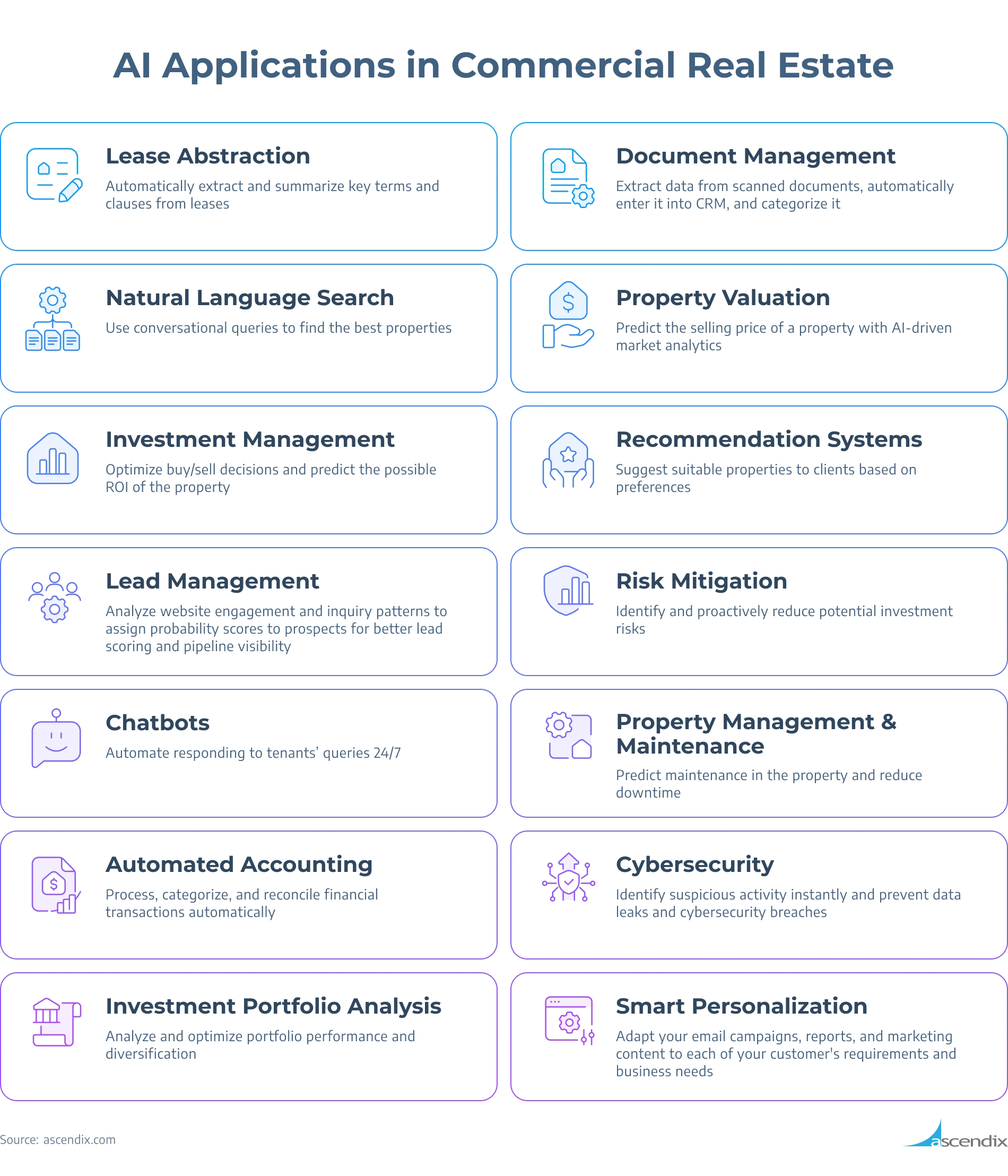
Some of the key applications of AI in CRE include automated lease documentation analysis, predictive maintenance systems that prevent equipment failures, and real-time market analysis. AI automation helps CRE professionals avoid common issues like missed maintenance problems, outdated investment reports, and lost client prospects.
AI In Commercial Real Estate Use Cases
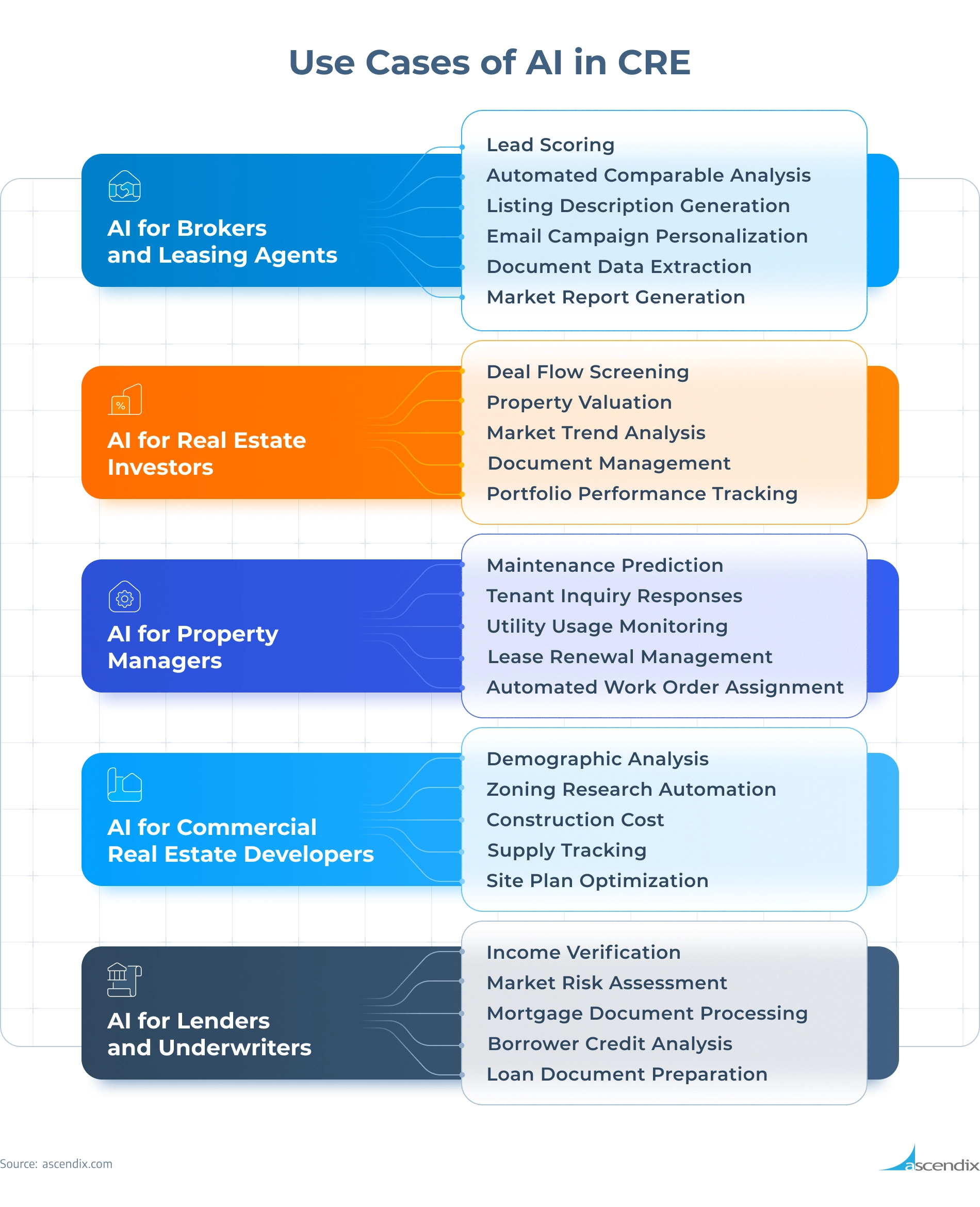
Use Cases of AI in Commercial Real Estate | Ascendix.com
The benefits and drawbacks of AI implementation are clear. Let’s now discuss how AI tools for commercial real estate transform workflows for each key role.
For Brokers and Leasing Agents
- Lead Scoring. AI can analyse the leads from your website, their engagement, and inquiry patterns, and then assign probability scores to prospects, helping brokers focus on leads most likely to convert. An example of it is Agentforce SDR AI agent – an independent agent that completely integrates into your Salesforce system and acts as your virtual assistant.
- Automated Comparable Analysis. With NLP integrated in your systems, commercial real estate AI extracts property data from MLS listings and public records, and then algorithms identify comparable properties based on the number of chosen attributes such as location, size, age, and amenities.
- Listing Description Generation. You can easily entrust the creation of property descriptions to AI. While ChatGPT can work just as well for this task, you can also try dedicated CRE AI tools, which are trained on successful real estate listings and will create compelling property descriptions after you’ve input basic property features.
- Email Campaign Personalization. As your trusted email marketing assistant, AI can analyze contact databases and then customize and adapt the email content and timing accordingly to win your clients’ engagement and trust.
- Document Data Extraction. Powered by optical character recognition (OCR) technology, combined with NLP, AI document abstraction tools pull key terms from leases and contracts and automate data entry into CRM fields.
- Market Report Generation. AI aggregates data from various sources in your system to create neighborhood reports with charts and insights, though it is required to verify and interpret the summaries and recommendations.
For Real Estate Investors
- Deal Flow Screening. Commercial real estate AI algorithms monitor listing sites and public records for properties matching preset criteria (location, size, price range, etc.), sending daily alerts for your review.
- Property Valuation. Based on the recent sales of similar properties and the thorough analysis of property features, location, and state, AI valuation tools provide rough estimates of the property value for real estate investment AI insights.
- Market Trend Analysis. Having analyzed historical data in the area, AI can project rent growth and vacancy rates in the ‘ideal’ scenario without any unexpected events influencing the prediction.
- Document Management. OCR & NLP are the perfect combination of technologies for automated documentation management, as they not only can scan, summarize, categorize the documents, but also recognize text from images and handwriting, highlight unusual clauses in agreements, and identify missing documents in due diligence checklists.
- Portfolio Performance Tracking. AI in commercial real estate consolidates data from property management systems and creates reports showing general investment market trends, occupancy changes, and maintenance costs.
For Property Managers
- Maintenance Prediction. Provided that AI commercial real estate tools are connected to IoT sensors in the managed properties, you can automate tracking of equipment runtime hours and performance metrics, as well as identify patterns that preceded past failures to schedule preventive service and proactive maintenance.
- Tenant Inquiry Responses. There are two options for how AI in commercial real estate can streamline managing inquiries. First, AI chatbots handle basic questions about office hours, maintenance requests, and payment methods by matching keywords to predetermined responses, escalating complex issues to staff. Secondly, fully independent AI agents, like the Service agent by Agentforce, integrated in your Salesforce system, manage all the inquiries without human intervention, as they have access to the complete business context and can resolve issues on their own within the defined area of responsibility.
- Utility Usage Monitoring. AI in combination with IoT can analyse meter data to identify unusual consumption patterns and then alert managers to potential leaks or equipment malfunctions for investigation.
- Lease Renewal Management. Based on the payment history, maintenance requests, and lease agreement terms, AI assistants can alert property managers about the need to renew the contract and/or flag tenants who are likely to vacate the property.
- Automated Work Order Assignment. Independent AI agents, like the ones by Agentforce, can be set up to match maintenance requests with relevant technicians based on skill sets, location, and workload. However, to accomplish it, the system must have a defined list of contractors and all the data about their services and schedule, which means managers will have to override high-priority issues.
For Commercial Real Estate Developers
- Demographic Analysis. With access to publicly available demographic data, AI can gather information and analyze it to map population density, businesses registered in the area or nearby, population income levels, and consumer behavior by location.
- Zoning Research Automation. AI extracts permitted uses, height restrictions, and parking requirements from public municipal code databases and provides summaries or overviews. This may be of great use even for experienced developers in cases when there are updates to policies, changes in requirements, and any newly introduced patterns. You must remember, though, that AI lacks legal expertise, so it is still advisable to have a dedicated person review the findings.
- Construction Cost. AI maintains updated pricing databases by analyzing recent project bids and material costs, providing baseline estimates that contractors will then refine and actualize.
- Supply Tracking. Similar to zoning research automation, AI in CRE algorithms monitor building permits and news articles to identify planned developments, helping assess future supply in target markets.
- Site Plan Optimization. The feature typically inserted in the BIM and construction & design tools, AI for commercial real estate site plans can create multiple building configurations, maximizing rentable area within zoning constraints.
For Lenders and Underwriters
- Income Verification. With OCR algorithms, lenders and underwriters can manage the documentation for loans faster, as they will be able to extract income figures from tax returns and bank statements, calculating debt service coverage ratios instantly.
- Market Risk Assessment. Instead of sifting through dozens of property features, records, and images manually, commercial real estate AI automatically compares subject property metrics to submarket trends, identifying when properties deviate from local norms.
- Mortgage Document Processing. AI automatically validates borrower information across multiple touchpoints. The system can cross-reference employment history, verify asset statements, and flag inconsistencies, making data verification significantly faster, therefore, speeding up decision-making.
- Borrower Credit Analysis. To make the loan safe and beneficial for both borrower and lender, AI can be used to aggregate data from credit bureaus, bank statements, and public records to create comprehensive borrower profiles, highlighting risk factors for manual review.
- Loan Document Preparation. With generative AI in commercial real estate, lenders (and everyone in the sphere) can easily generate the loan documentation in seconds, which then will just need to be reviewed for accuracy. Loan documentation templates also can be automatically populated by AI-extracted data from the CRM or the borrower’s records provided to the lender.

You May Also Enjoy

Seven things to do if a tree damages your property

Leasing demand rises across all sectors
Don’t Put The Property Market On Pause

Before You Sign: 10 Things Home Movers Wish They Knew

Property expert warns homeowners to lock in amid mortgage rates uncertainty